Michael Haneke's Caché: Postcolonial Subtexts, Clinical Styles, & The Myth of Objectivity

Serious Spoiler Warning
Rarely do I have as much to say about a film as I do about Michael Haneke’s 2005 psychological thriller Caché. In order to do so, I’m going to break down the plot, then follow this with some analysis of its subtext and style. Of course, this will entail spoiling the film, and so I strongly encourage watching this movie first if it is of any interest to you, as there are very few films where going in “blind” is as integral to the experience as it is with Caché. Not only does Caché stand out in Haneke’s accomplished career, but it truly is a landmark of twenty first century cinema, for a number of reasons I hope to delineate.
Caché has a fairly ingenious premise. A co-production of multiple European countries but shot and set in Paris, Caché concerns an upper middle class couple, Georges and Anne Laurent, and their adolescent son Pierrot. The film opens on a shot of their house, as the opening credits slowly populate the screen; once the credits fade away, we hear the voices of Georges and Anne discussing the happenings (or lack thereof) occurring on screen. The camera cuts to a shot of Georges walking out into the street, staring at the location from which the opening shot seems to originate, and then reentering the home. We return to the opening shot, which is suddenly rewinded by Georges. It becomes clear, through the dialogue as well as Georges’s rewinding of the shot that we are seeing, from a first-person perspective, footage from a videotape left on the couple’s porch.
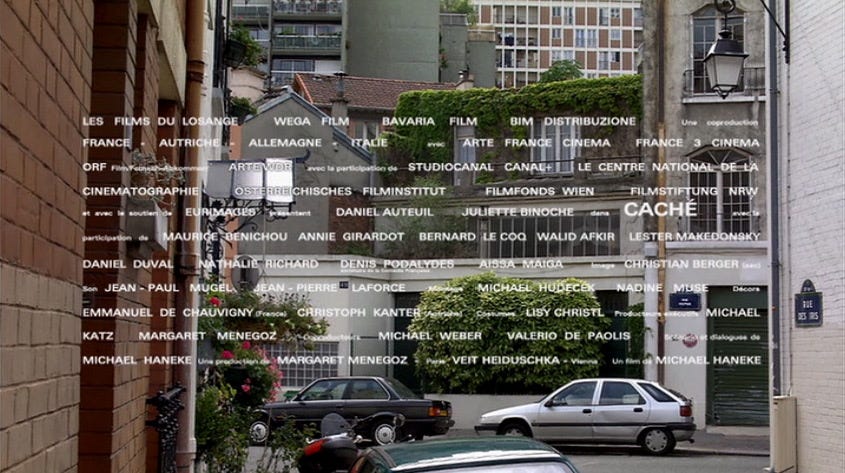
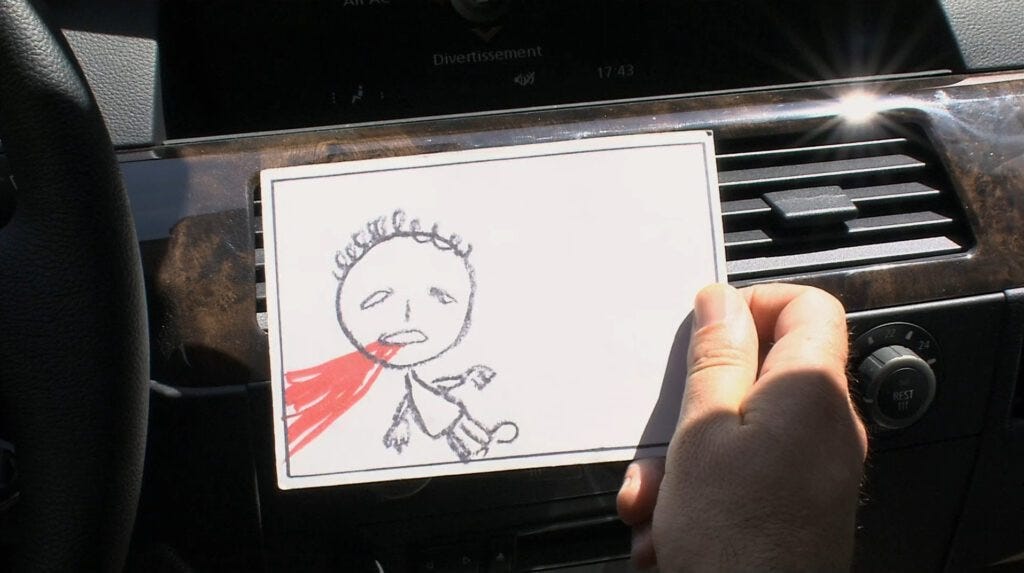
According to Anne, the tape runs for around two hours and merely films the couple’s house, including both Anne and Georges leaving for work. Most unnerving, the video is steady, does not appear filmed from a car, and Georges appears to look right into the lens at one point in the video, despite having no memory of seeing a camera. Therein lies the sly brilliance of Caché: Haneke’s fusion of the lens of the film’s cinematography with that of the in-movie videos being sent. Without Anne and Georges’s discussion, and the act of rewinding the tape, we couldn’t tell the difference. A second tape arrives while Georges, who hosts a literary talk show, is at work, this time wrapped in a paper with a crude drawing of a person vomiting blood. While the camera shows the tape of Georges arriving home one night, we are suddenly confronted with a brief clip of a young boy turning around, blood covering his mouth and nose. The clip does not have accompanying audio, merely interjecting itself and leaving as abruptly as it came. As the tape continues rolling, Anne can be heard trying to get the attention of Georges, who is apparently spaced out, and eventually comes to and asks to see the drawing again, remarking that it looks like a child’s drawing. It becomes clear that this clip was not part of the tape, but rather a sort of intrusive memory being experienced by Georges.
Georges receives a similar drawing on a postcard at work, and later, Pierrot receives a nearly identical drawing at school, both from an anonymous source. We are then placed in a point-of-view shot looking out of the Laurent’s home towards the location where the tapes seem to be filmed from in the street (it took me a number of viewings to realize this is Georges’s point of view) and another flashback cuts in. This time, there is audio, and the clip lasts a bit longer. The camera moves around a corner, showing the same boy as before coughing up blood, who turns and looks at the unseen spectator. Another tape arrives during a dinner party at the Laurent’s, this time wrapped in a drawing of a chicken bleeding from the neck, and filmed through a car window. It shows what Georges reveals to Anne and their friends to be his childhood home.
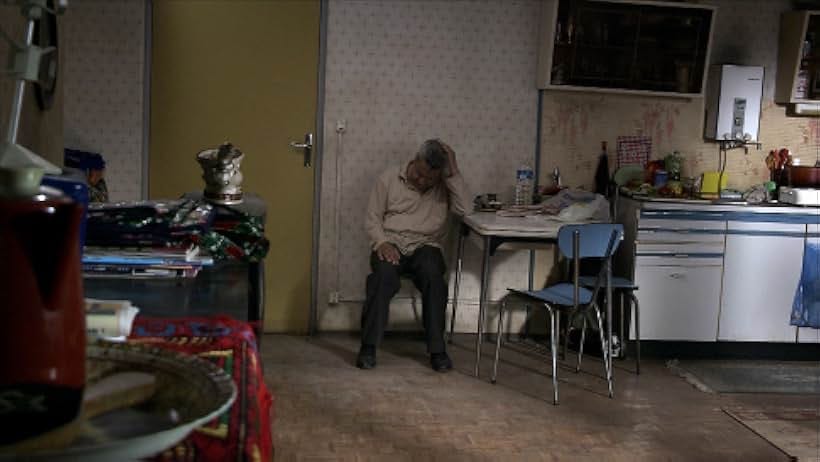
Georges visits his mother while traveling for work, who still lives in the home shown in the previous tape. He asks her about someone named Majid, telling her she dreamt of him, but she is vague when discussing this individual, telling Georges he knows “all too well” that it is not a happy memory and that she chooses not to think about him. Georges bids his mother goodnight, then calls Anne to wish her goodnight as well. Suddenly, we are presented with another flashback. This time, the boy seen coughing up blood previously (presumably Majid) chops the head off of a chicken and tosses the headless body to flop around, spraying blood. The boy menacingly approaches another, younger boy (presumably Georges) with the bloodied axe, and raises it as if to strike him. Georges wakes up in the present from the nightmare, soaked in sweat. That morning, he visits the same spot in the home where Majid was seen coughing up blood in the previous flashbacks before departing.
Another tape arrives, filmed through a moving car, showing the location of a flat. Georges and Anne are able to discern the precise location from a street sign shown in the tape, and Georges reveals to Anne that he believes he knows who is sending the tapes, but cannot tell her. Unsurprisingly, Anne is very upset, but Georges remains steadfast that he must visit the flat shown in the tape before he can fill her in. Georges visits the flat, where the now middle aged Majid is living. Their interaction is genuinely harrowing. Majid claims ignorance regarding the tapes, even after being shown one of the drawings. Some of the dialogue is among the most heart-wrenching Haneke has put to script, with Majid at one point asking:
“Why do you talk like we’re strangers? You wouldn’t recognize me, huh? Outside you’d have walked right past me.”
He goes on to admit he saw Georges on his television program several years back and recognized him once his name appeared, but continues to deny knowledge of the tapes or drawings. Georges tells him to leave his family alone, openly acknowledges that he is threatening Majid, and departs.
If the manner in which the tapes were being filmed and delivered was already verging on difficult to believe, Haneke takes things a step further when a tape is delivered that was filmed inside Majid’s apartment and displays the conversation between him and Georges. We see a continuation of the scene after Georges leaves; Majid breaks down in tears, sobbing uncontrollably until Anne stops the tape, noting that it continues for nearly half an hour. She accosts Georges for lying to her and demands answers, which Georges reluctantly provides. Majid’s parents, Algerian immigrants who worked for Georges’s family, went to an FLN demonstration in Paris in which they were presumably drowned by the police in the Seine, as they never returned (a real life event from 1961 - remember Algeria was still a French colony at the time). Georges’s parents planned to adopt Majid, likely out of guilt, which upset the six year old Georges. He told lies about Majid, but claims he cannot remember what they were about due to his young age at the time. Nevertheless, in response his parents sent Majid to an orphanage rather than adopting him. In the interim, Georges had never given any thought to Majid.
Anne points out that Majid would have had no way of knowing Georges was coming and been able to set the camera up to record them, deepening the mystery and lending credence to Majid’s claim to have no involvement in producing the tapes. When Pierrot fails to come home from school, Georges immediately sends the police to Majid’s flat, where we discover he has a son in his early twenties (this character is never named - I’ll refer to him as Majid’s son). Both men are arrested, then released due to lack of evidence. Georges assumes Majid’s son was the one responsible for the tapes, and Pierrot returns home and gives a fairly unsatisfactory answer regarding his absence - he stayed at a friend's house and forgot to phone home. During his discussion with Anne, Pierrot appears to have some antipathy toward her regarding her relationship with her boss Pierre, a relationship which we are shown in a brief yet key scene may in fact be a full blown affair. Anne denies anything is going on between her and Pierre. Meanwhile, Georges receives a phone call from Majid while at work, requesting he come to his flat again to talk about the tapes.
The following scene is perhaps what Caché is most infamous for - having watched it with many people, it nearly always elicits genuine, audible shock from them, including from myself the first time I saw it. Majid lets Georges in and we are placed in a static shot of the interior of Majid’s flat, facing the door, nearly identical in composition to that of the tape in which Majid is shown breaking down in tears. Majid insists he had nothing to do with the tapes, to which a frustrated Georges asks if that is all Majid wanted to say. Majid replies that he also called Georges there because he “wanted [him] to be present,” and pulls a razor out of his pocket. Majid then slits his own throat, sending a graphic arc of burgundy blood spraying onto the wall, and collapses to the floor, gurgling as he chokes to death. The almost unbearable tension that had been built up for the past ninety minutes is suddenly and unceremoniously released via Majid’s jugular vein.
Haneke has, especially in response to films such as Funny Games (1997) and The Piano Teacher (2001), faced charges of sadism in the past. Yet he has tirelessly argued across his career that his relentless display of disturbing violence is precisely the opposite of sadism, as it refuses to revel in or aestheticize the suffering and brutality it portrays. His clinical portrayal is intended to reflect how violence presents itself in reality. He resents the presentation of violence for entertainment or - god forbid - for humor. There’s nothing funny about Caché. It is entertaining, but in a dreadful, foreboding, highly disturbing way. I’ve seen the film many times, but a lot of people describe it as a movie they only need to see once. I completely understand and empathize with that perspective.
But the movie isn’t over yet, and Georges is confronted by Majid’s son at work, who rather effortlessly coaxes him into disparaging Majid postmortem for his “sad, wrecked life” and insists he feels no guilt over it. Majid’s son tells him he merely wanted to know how Georges felt having a man’s life on his conscience, but notably denies any involvement with the tapes when Georges accuses him of being the one responsible. Georges returns home early and goes to sleep, where we are confronted with a brutal flashback/dream of the day Majid was sent away. Shot in the same static, far away nature as the tapes (presumably from the young Georges’s point of view), Majid attempts to run, but is chased down and aggressively forced into a car and driven off. It’s a grueling scene, and quickly undercuts Georges’s insistence that he doesn’t feel any guilt over Majid’s fate.
This scene would have made an excellent closing scene to the film. But Haneke pulls off an almost unbelievable sleight of hand in the actual final shot - one that I along with most people who view the film for the first time completely miss the significance of as a result of Haneke burying the lead in plain sight. The final static, long take of the exterior of Pierrot’s school - similar to one that appears earlier in the film when we see Pierrot being picked up by Georges - shows Majid’s son approach Pierrot as he talks with his friends outside the school. He pulls him aside and the two have a brief conversation. Their discussion is inaudible, but their body language is familiar and amicable. They depart in opposite directions, and as soon as Pierrot leaves the screen, the credits begin scrolling across the screen.
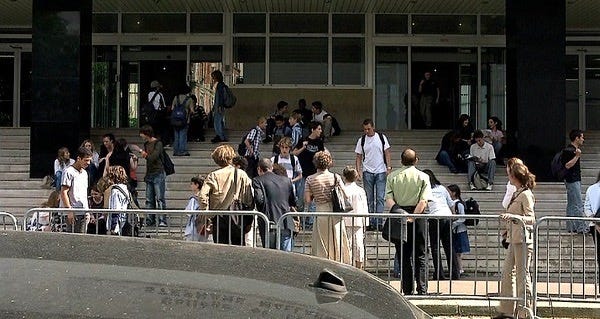
The first time I saw Caché, what I saw was a bunch of extras loitering in front of the school for several minutes before the credits rolled. Not until I dove into the assigned reading (I initially saw the film as part of a 21st century world cinema course in college) did I realize I had missed the elephant in the room. To be fair, most people do, and that was to a degree Haneke’s intention; not to hide the smoking gun, but to deemphasize it. The smoking gun, of course, is that these are two characters who should not know each other, yet this does not appear to be their first meeting, which completely upends how we understand the events of the film. Majid’s ability - and motive - to produce and deliver the tapes had always been in question. But his son, working in conjunction with Pierrot, who is angry about what he suspects is his mother’s affair with her boss, whose whereabouts are often unknown, and who had skirted any suspicion, could easily have assisted in filming and leaving the tapes at his own home. It is, in essence, the only plausible explanation.
Objectivity is a tricky thing. To claim objectivity in narrative fiction is to claim the position of an unbiased, impartial observer. Part of the allure of fiction, I would argue, is that objectivity is often guaranteed as at least one lens through which a work can be viewed. What makes Caché such an uncomfortable watch, aside from its decidedly disturbing content, is that it refuses this luxury for the viewer. The apparent revelation at the end in a way only deepens the mystery in a lot of ways. We technically don’t even know for sure where it resides in what is an otherwise linear storyline. How did Majid’s son initially find and come into contact with Pierrot, much less convince him to terrorize his own parents? How did these high quality videos get shot, produced, and developed without the culprit ever being noticed? The film’s apparent realism is called into question - unusual for Haneke. Things are further complicated by the fact that virtually any static or point-of-view resembling shot could in theory be another tape. Even the ending scene that seemingly reveals our culprits could just be yet another tape in an endless cycle. It has all the hallmarks, after all: a distant, static shot, filmed in Haneke’s signature clinical style. Indeed, the essential dilemma Caché poses is that its style practically insists it is being objective, yet its content gradually unravels that notion. This juxtaposition makes an already unnerving film that much more confounding; the lack of finality of its closing scene leaves a pit in the stomach.
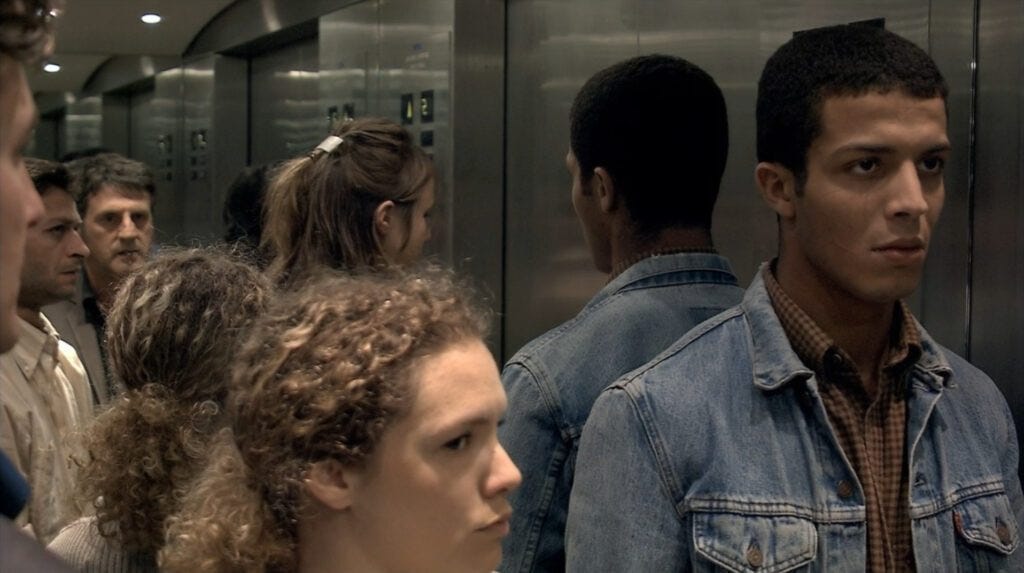
What do I mean by clinical? I’ve used the term a few times now. It typically invokes the medical field, but what I mean in this context is (per Merriam-Webster) “analytical or coolly dispassionate.” Haneke has always applied a clinical style to his filmmaking, but in Caché this style is intertwined with the narrative via the tapes, which are necessarily of a clinical style. Surveillance is clinical. Haneke eschews ornamentation in his cinematography to produce a blunt realist effect; stylistically, this manifests in both the static camera angles and rigid, carefully executed tracking shots. The framing in some scenes, particularly in regards to building tension, is magnificent. The long take of Majid’s son confronting Georges begins with Georges entering work and talking briefly with a woman, when Majid’s son enters the shot from the left, only the back of his head visible, but we can instantly recognize who he is - the dread manifests instantly. After Georges attempts to dismiss him, he follows Georges into the elevator, and the scene is shot so that Majid’s son is in frame, staring at Georges, who appears in the reflection of the mirrored wall, without saying a word. Majid’s son follows him when he gets off the elevator, and the confrontation continues. There is no music throughout the entire film, and this is particularly effective in scenes like this one, where we are forced to sit through over a minute of a silent elevator ride with two characters who may be about to come to blows. The result is that it feels like an eternity. Additionally, the leadup to Majid’s suicide completely lacks any sort of conventional cinematic cues that anything of that caliber is about to occur, allowing its shock value to deliver completely undeterred.
There’s an abstract, difficult to grasp lens through which we can contemplate Caché’s complexities. It may sound a bit absurd on the surface, but nevertheless I believe it’s worth exploring: what if Haneke himself was “sending the tapes”? I should clarify that I don’t mean this in a particularly literal way, as a sort of self-serving fourth wall break. But in a film where the camera lens is such a focal component of how we experience the content, it doesn’t seem too far removed from that frame of reference to suggest Haneke is displaying the power of the director in manipulating the viewer and their expectations. This can be seen even from the opening shot. The opening credits appear over the very first tape that arrives. It goes without saying that these credits do not appear in the canonical tape sent to Anne and Georges, but we as the viewer are presented with them in this manner. Haneke could have easily placed the opening credits elsewhere, so why here? It’s a stylistic choice, sure, but it lends credence to the idea Haneke is priming us to think about where the fourth wall begins and ends. How does Georges not see the camera recording him in the first tape? He looks directly at it and goes so far as to comment on this fact. Haneke is in control of both camera and script: he alone decides who sees what. How could Majid have known Georges was coming? Anne comments on this fact after receiving the tape. Additionally, this would implicate Majid, not his son or Pierrot as the final scene does. Haneke could have easily placed the camera there - he’s in control. If Georges lied about Majd coughing up blood, why did he have memories of it happening? Surely Majid never actually attacked him with an axe after killing the rooster, either. It’s as if Haneke is reaching into the narrative and exploring the fallibility of memory, plumbing the depths of Georges’s guilt in a way he couldn’t do as an objective observer.
Where is Haneke leading us? He forces the viewer, at one point, to watch graphic news coverage of the conflicts in the Middle East taking place at the time of filming while Georges and Anne are panicking over Pierrot’s disappearance. It may be heavy handed, but it’s a notable example of the director openly prompting the viewer to think about something seemingly unrelated to the events on screen. In fact, I would argue the film’s postcolonial subtext is among the most salient. I say this because Haneke seems to suggest that the then-ongoing Iraq War, specifically the grounds for invasion and continued justification, was the product of its own ostensible narrative, conjured up and relentlessly trumpeted by those in power, with its own false claim of objectivity. Just as the 200 Algerian activists were drowned in the Seine in 1961, a story he personalizes by incorporating it into Majid’s childhood, Western forces continue to dominate and brutalize the Arab world. History, Haneke suggests, is repeating itself, because the narrative is controlled by people with the same interests and the same motives as during the era of colonization. People like Georges, however far removed they may seem from the levers of power, wield a degree of influence visible when he easily has Majid and his son arrested and mistreated with no evidence of their involvement in Pierrot’s disappearance. Majid himself dies by suicide, as he feels his only remaining avenue of punishing Georges is to take his own life, violently, right in front of him.
Georges seemingly came around to accepting Majid had nothing to do with the tapes, and shifted his blame to Majid’s son accordingly. But there’s a truly unforgettable moment during their confrontation when Majid’s son unilaterally denies involvement in their production. Actor Daniel Auteuil deserves credit for nailing the expression on Georges’s face, as he clearly at least momentarily believes him, and can be seen mentally grasping for answers. Georges points out that Majid had denied involvement as well, and Majid’s son simply replies “believe what you want, I’m not lying.” Believe what you want, he tells Georges. That line perhaps most accurately encapsulates the message I take away from Caché every time I watch it. With several options for who was sending the tapes (Majid, Majid’s son with or without Pierrot’s help, another unseen character, Haneke himself) one can drive themselves crazy trying to solve this truly intractable puzzle. Any avenue for understanding Caché in a logical sense requires picking an explanation and willfully disregarding any contradictory evidence. Haneke, for his part, seems to recognize that most people choose what they believe, whether consciously or not. Caché has enough happening on the surface that this layer can be difficult to unearth, and that may very well have been Haneke’s intention. He would much better get his point across, in however obtuse a manner, by having people prove it for him through endlessly debating the narrative than self-awarely engaging with the even richer subtext - so rich I may have to revisit this film here in the future.
Great analysis! I remember you had to point out the son’s meeting in the final scene otherwise I would have missed it too!